

Hundreds of Legal Washington Immigrants Set to Lose Life-saving Care
September 25, 2026 - 12:09 pm
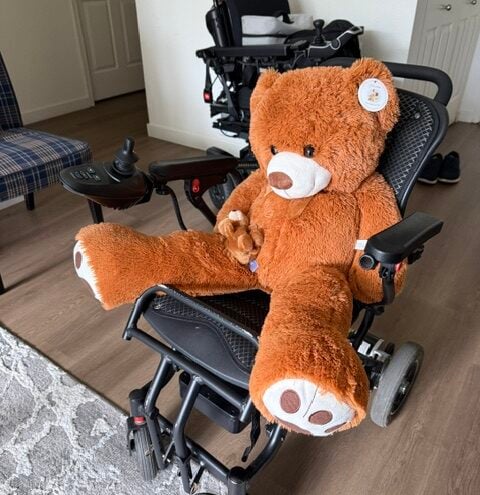 Teddy bear given to the client by her boyfriend. Photo by Jennie Cecil Moore.
by KBCS contributor Jennie Cecil-Moore
On Oct 1, 11,000 refugees, asylum seekers and other immigrants in Washington State are going to lose their health insurance according to the governor’s office. That includes hundreds of people who need round the clock care. HR 1, President Trump’s so-called “Big Beautiful Bill,” will cut $1 trillion from Medicaid and other health programs over the next ten years. These most vulnerable immigrants are the first group of people to be targeted.
In a clean, tidy apartment on the Eastside, light is pouring through a bank of windows. I’m here talking to a family who left Ukraine in 2022 because of war and came to Washington as asylees. They said their new home was so green and beautiful.
A person in their twenties sits on the couch here between their mother and boyfriend. We’re going to refer to the person in their 20’s as “the client” and we won’t use names, voices or share their gender for privacy. Their case manager, Ihor Hlushchenko, interprets as we talk. He works with Chinese Information and Service Center, an organization that supports local immigrants.
The client’s life in the US was turned upside down when they started to experience health problems. They and their boyfriend went on a hike to the mountains. What they noticed was weakness in their legs and arms.
Symptoms got worse, and in March 2023 the doctor started talking about the diagnosis. It was ALS, a nervous system disease. It’s been three years since the diagnosis, and now the client is fully dependent on others for care.
They explain that they cannot walk, they cannot eat, they cannot dress, turn or reposition.
JCM: The client used to love hiking, going for walks, and biking. Now everything’s changed. When the family got here, they went to the social services office and were enrolled in Medicaid right away. The client’s mom said it was easy. Their current plan covers everything. It’s been really hard waiting to find out if they’ll lose coverage in October.
Hlushchenko: As a mom, I used to work at another workplace when the health condition of my daughter changed. I had to become a caregiver for her and got employed as a caregiver. These changes mean that I will lose my job and this also puts into question how to afford paying the rent.
JCM: This family is not alone. The client is in a category of care that requires long-term support services. That means Medicaid pays for a caregiver who helps with basic things like eating, toileting, getting out of bed and showering. The federal government is eliminating Medicaid for some legal immigrants on October 1. Around 900 people who rely on long term support services in Washington state stand to lose their coverage according to Lee Che Leong. She’s a senior policy advocate at Northwest Health Law Advocates. And she explains that Washington state tried to fix this.
Leong: Washington budget writers this spring recognized the cruelty and the moral bankruptcy, to use Governor Ferguson’s words, in the federal legislation and worked hard to allocate funds to mitigate some of the worst harms.
JCM: But continued the federal cuts and policy changes are leaving them short. Now only 184 of those legal immigrants who need life-sustaining long-term care will receive state coverage on October 1.
Leong: Washington is struggling with filling this new gap because the rich don’t pay their fair share. Oregon, California are using state funds to continue health coverage for immigrants. Massachusetts is continuing coverage for people who are elderly or disabled.
JCM: Northwest Health Law Advocates filed a lawsuit against the US Department of Health and Human Services. And with coverage ending in just a few days, advocates are telling people to see their doctors, refill prescriptions, and talk to their healthcare navigators while they still have Medicaid.
Leong: There’s going to be lots of mail coming telling them what’s going to happen. People may be surprised. People who get termination notices are likely to be scared. We encourage people to talk to navigators to figure out what their options are.
[sound from the apartment]
JCM: Back at the apartment with the family from Ukraine, I notice a teddy bear on the client’s wheelchair and ask if I can take a photo.
[sound of Hlushchenko in Ukrainian]
Everyone smiles – it was a gift from the client’s boyfriend.
A few days after I left, they found out that they’re one of 184 people who will get state coverage. Leong says close to 700 legal immigrants statewide are still expected to lose their life-sustaining long-term care on October 1. Her group is calling on Governor Ferguson to use emergency funds now to help them. Find resources and ways to get involved at KBCS.FM.
For KBCS news, I’m Jennie Cecil Moore.
Resources:
1) People on Apple Health should check their mail and connect with their provider before 30 Sept if coverage is ending.
2) NoHLA (NW Health Law Advocates) urges everyone to contact their WA state legislators to urge them to support a health safety net for all Washingtonians and dedicated health revenue:
For those who want to get more involved, the No Cuts to Health Care Coalition (NC2HC) unites medical providers, labor unions, immigrant rights organizations, health care & disability advocates, and community groups across Washington who believe it is essential to strengthen our state’s health safety net to protect Washingtonians from federal attacks.
NC2HC calls on all WA state policymakers to address this health care crisis with policy and revenue solutions. We ask Governor Ferguson to use emergency funds to help those losing essential care October 1. This coming session, we ask policymakers to support policies to keep health entities accountable for our taxpayer dollars, hold corporations responsible for their fair share, and raise targeted health safety net funds so all Washingtonians can get the care they need.
Contact the Governor to support efforts to mitigate HR1 impacts: Governor Ferguson signs executive order to mitigate impacts of H.R. 1 | Governor Bob Ferguson .
Organizations and advocates see the best outcomes when people reach out to their elected representatives with specific stories about how they, as constituents, are being impacted by policy changes and demonstrate that they know how the legislator has voted on the issue (either way).