

Never Again is Now: Mural on Bellevue College Campus Honored in Dedication
June 18, 2026 - 5:00 am
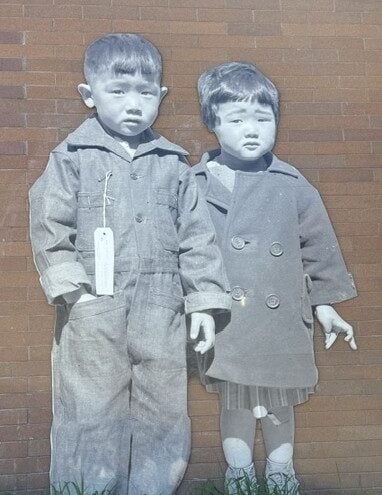 Photo by Jennie Cecil Moore.
It’s been six years since Erin Shigaki’s mural was installed on the Bellevue College campus. Depicting two Japanese American children being sent to a concentration camp, the mural was defaced soon after its unveiling. On June 11, it was dedicated in a ceremony and made permanent at the college. The event featured performances by Blaine Ukulele Group of Seattle and Seattle Kokon Taiko drummers. KBCS producer Jennie Cecil Moore has the latest on the mural’s story.
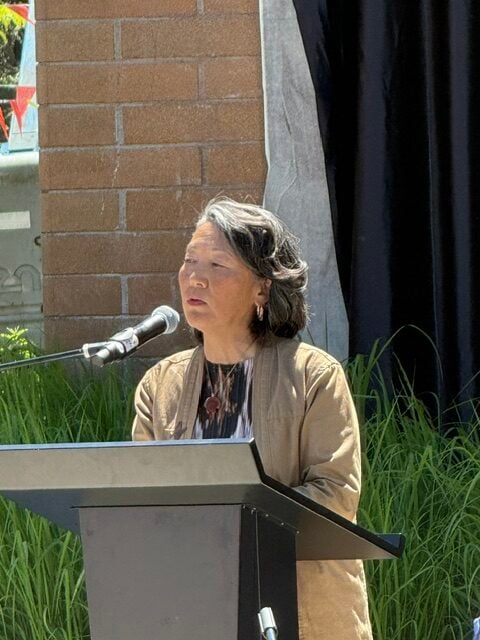
Mural artist Erin Shigaki at the podium. Photo by Jennie Cecil Moore.
HOST: Two Japanese American children, fear in their eyes, prison tags pinned to their clothing. It’s a mural at Bellevue College that shares the local history of the mass removal of Japanese Americans. When it was installed six years ago, its story took a turn when it was quickly defaced. But last week, the college rededicated the mural and made it permanent. KBCS producer Jennie Cecil Moore was there.
JCM: On a sunny afternoon in early June, ukulele players in matching hats performed for a crowd in the Bellevue College Fountain Courtyard. Bellevue College President David May opened with a few words.
MAY: What happened here to this mural six years ago was wrong.
Applause
MAY: Real harm was done to the artwork. Real harm was done to the history that it represents. And real harm was done to our communities.
JCM: This is not the first time the mural’s been in the news. Next to the mural, a plaque detailed Bellevue’s anti-Japanese actions and named high profile businessman Miller Freeman for being a vocal anti-Japanese agitator. When it was installed in 2020, a Bellevue College vice president had those words whited out and people were outraged. In the fallout, the college president and vice president resigned.
Note that KBCS is licensed to Bellevue college, but the editorial decisions are completely independent from the college.
Erin Shigaki is the artist who created the mural. She talks about how she felt about the censorship.
SHIGAKI: I was really hurt, confused, angry. I had a lot of disbelief, you know, that history which has already been so covered up, concealed, whitewashed, that that was happening again.
JCM: The permanent metal installation features Dorothea Lange’s photograph of two Japanese American children. A boy in a jump suit with rolled cuffs, and a girl in a scruffy overcoat. They’re being sent to a temporary prison camp in Turlock, California. The words “Never Again is Now” are next to the mural.
SHIGAKI: I was very drawn to this image because I was thinking about my aunt and uncle as children in prison camp and my dad and lots of people I knew. And their faces are scared and their hands are anxious and their clothing is shabby and they’re pure. They’re just pure innocent children. Getting ready to go into a concentration camp.
JCM: 120,000 Japanese Americans were incarcerated across the U.S. between 1942 and 1945 under executive order 9066. That included around 300 people who lived and worked in Bellevue, mostly on farms.
SHIGAKI: Miller Freeman swept up land that these Japanese American farmers lost. You know, a lot of them weren’t citizens and couldn’t own and so they had handshake agreements. And this is the land that we’re standing on. Bellevue Square is on, all of downtown Bellevue.
JCM: Linda Joko was at the ceremony, and she’s an organizer with Tsuru for Solidarity. They document deportations at Boeing Field and detentions at the NW detention center in Tacoma, a place that Joko says has a lot of similarities to the Japanese American concentration camps.
JOKO: Like the treatment for my family, my community, was the same. Terrible food, lack of health care, just inhumane treatment. It’s so close to what’s happening now. So I, you know, I ask myself what kind of ancestor do I want to be? Because nobody was there for us.
JCM: Towards the end of the ceremony, a singing bowl rang while Shigaki, the artist, read out the names of 10 concentration camps.
Sound of singing bowl
JCM: Shigaki says she hopes the presence of the mural on campus will help people see parallels to other parts of history.
SHIGAKI: I just don’t want it to be history in a silo and I think that’s a tactic to keep us apart, right? And my mind is just really on the students that come through here and what they can learn from this. And not only learnings about World War II and my community’s incarceration, but really in my mind how it’s all linked together including what’s going on right now with ICE detentions.
Sound of taiko drums
JCM: The mural was unveiled with the sound of taiko drums filling the courtyard. For KBCS news, I’m Jennie Cecil Moore.
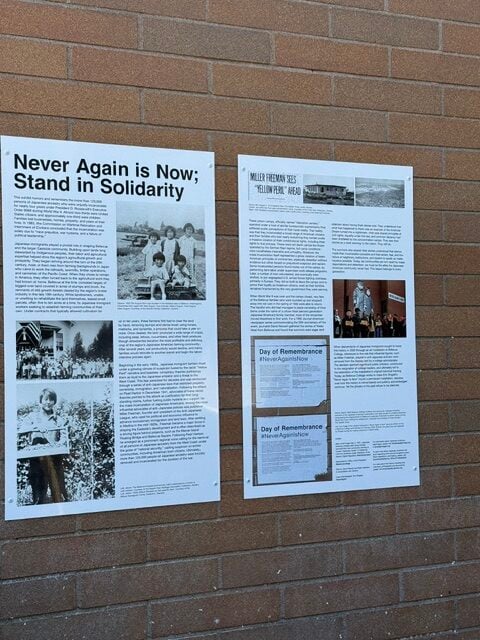
Mural plaque at Bellevue College. Photo by Jennie Cecil Moore.
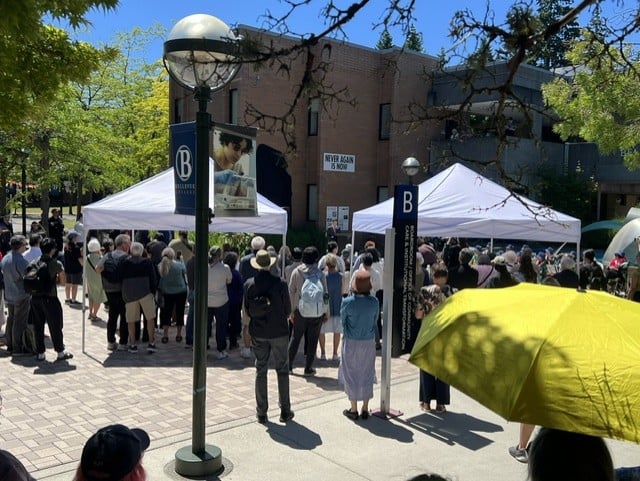
Rededication of “Never Again is Now”. Photo by Gregory D’Elia.
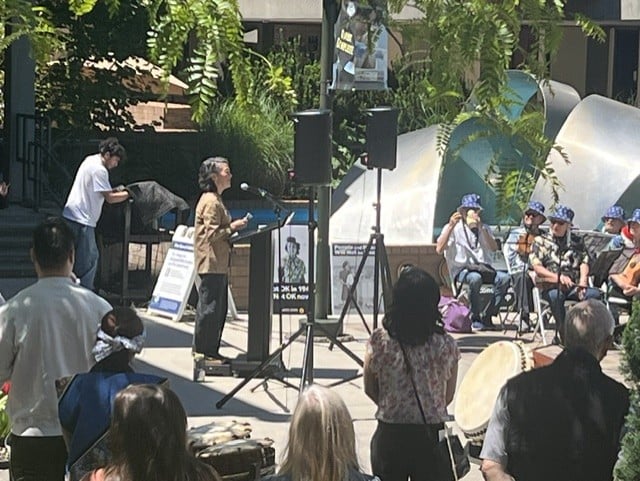
Erin Shigaki artist, speaking at rededication of “Never Again is Now”. Photo by Gregory D’Elia.