
The Wealthy Funder Behind Washington’s Ballot Initiatives
October 27, 2026 - 9:00 am
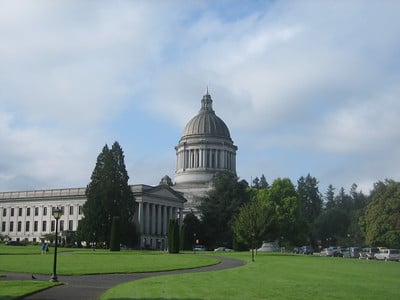 "Olympia, WA" by jodastephen is licensed under CC BY 2.0.
Election Day is on November 3rd, and there are three statewide initiatives on the ballot in Washington. I-645 would repeal the millionaire’s tax, I-001 would change parents’ access to school records, and I-638 is an extreme trans sports ban that would require all girl athletes to undergo an invasive exam. Conservative hedge fund founder Brian Heywood and his political action committee, Let’s Go Washington, are behind all three initiatives, and Heywood has personally contributed more than $10 million towards passing statewide initiatives since 2022.
Andrew Villeneuve, founder of the Northwest Progressive Institute, has followed Heywood’s efforts closely. He joined KBCS contributor Jennie Cecil Moore at KBCS’s studios to share his analysis.
Jennie Cecil Moore: Two of the initiatives on this year’s ballot particularly target vulnerable queer and trans students, and the other repeals the millionaire’s tax. And in your analysis, why is Let’s Go Washington and Heywood pushing these particular initiatives forward?
Andrew Villeneuve: Brian Heywood, philosophically, he’s very much this strong libertarian on economic issues, but then on social issues, he’s much more traditional Republican conservative. So his overall goal is basically to help Republicans turn Washington to Idaho. That’s how you can think of it. And since Republicans are unpopular and their brand is not doing well in Washington, Brian Heywood is pursuing the change he wants through the initiative process because that’s really the only vehicle available to him. Because with a ballot measure, there’s no D or R on the ballot. You’re just voting on ideas and you’re either saying yes to them or you’re saying no to them. So Brian Heywood is hoping that some of his ideas will get through.
JCM: Let’s talk more about Brian Heywood. What’s his background and his connection to the wider conservative or MAGA movement?
AV: So Brian Heywood is a wealthy hedge fund manager. He moved up here from California during the 2010s. He said to escape taxes in California, he believes fundamentally in a society where people just are pursuing their own profit. But fundamentally, Brian Heywood is a follower of Ayn Rand. And Ayn Rand is a libertarian philosopher who’s well known as having written Atlas Shrugged. And in fact, Heywood has named one of his companies after John Galt, the big character in Atlas Shrugged. His LLC that owns his Willowcrest Stables property is called Galt Valley Ranch, LLC. So it just shows you how committed he is to Rand’s ideas. And all of his anti-tax measures are aimed at sort of securing this libertarian utopia that he thinks should exist.
JCM: Many listeners may remember Tim Eyman, who put numerous measures on the ballot to slash tax revenue. Is Brian Heywood the new Tim Eyman? What’s his overall political strategy or intent?
AV: Yes, you could say that Brian Heywood is the new Tim Eyman. And in fact, Jim Brunner of the Seattle Times has described Brian Heywood as Tim Eyman with a gigantic bank account. So the comparison is pretty apt. Brian Heywood has now done initiatives in two election cycles. And Tim Eyman got like 12 on the ballot over 20 years.
So Brian Heywood is going at a faster pace and he can afford to do that because he has a lot of money. And so he can self-fund the initiatives. And the thing about initiatives, you can get anything on the ballot that you want. Any topic, any pet cause that you have, you can get it on the ballot if you have the money. You just pay the petitioners to go out and get the signatures and you will be on the ballot. And it does not matter what the issue is. It doesn’t matter how controversial it is. It doesn’t matter how well written it is. It’s just a matter of money and logistics. And that’s the way the system works. So Tim Eyman understood this and he usually could get at most one measure on the ballot in a single year. But Brian Heywood has the resources to do much more than that.
JCM: What do you think about these initiatives in terms of being part of the culture wars? Maybe something that’s meant to distract from affordability and things like that.
AV: I think the initiatives are an attempt to stoke the culture wars, at least 001 and 638 are. And it’s because the Republicans are looking for like a winning issue that can motivate their voters, turn people out. They’re hoping that maybe this will make them more competitive in candidate elections. I don’t think that part’s going to work. But A well-packaged culture war measure can serve effectively as a wedge issue that can divide and distract people. And I think 630 in particular fits the bill there.
JCM: So we’ve heard about Project 2025, the ultra-conservative playbook from the Heritage Foundation that has been part of Trump’s whole administration and policies. You wrote in The Urbanist that Washington State has its own Project 2025 called Future 42, and that Brian Heywood is also connected to that. Can you tell us more?
AV: Yeah, so Brian Heywood’s Future 42 is an organization that’s designed to secure for Republicans the future that they want in Washington, which I think is why they call it Future 42. 42 refers to Washington because Washington’s the 42nd state. And they’re thinking that this is a long-term project. So they’re starting at the local level and they’re trying to build power locally and then hoping that over time they will be able to get rid of Washington’s Democratic dominance, right? If we work at the local level and we get local wins and we elect people to local office, then eventually we’ll be able to win at the larger level.
And I think that they’re going to see a lot of erosion in Republican standing this year in the midterms. So it’s going to be really hard for Republicans to prevent losses at the state level in the state legislative races. People are looking to punish Republicans for Donald Trump’s performance or just because they don’t like how Republicans are governing. federally. And if you can’t vote against Republicans for federal office, you can vote against them for state office, right? So this is more of a long-term play, Future 42. It’s based in part on the idea that if we are working at the local level where a lot of elections are quote, nonpartisan, end quote, then we can avoid the damage to the Republican brand and still get people elected and then, you know, work from there and build our bench. And so that is what a lot of what Future 42 and Project 42 are, and they’re related to each other.
JCM: What does it have to do with the initiatives on this year’s ballot?
AV: Well, Future 42 and Let’s Go Washington are like siblings. You know, they’re different extensions, arms of Brian Heywood’s political operation. So it’s sort of like you can think of it like a multi-headed monster and each of the organizations that he funds are a different head, different facet of his political operation. When you’re wealthy, you can cede funding for a whole bunch of different political groups and they’re basically connected to each other, regardless of how you present them in public. They’re connected because the same funder is behind them.
JCM: So you also wrote about Heywood, how he’s influenced politics in Snohomish County. What’s he been doing up there?
AV: So in Snohomish County, they’re making that a focus or a nexus for their local organizing. So this is where Project 42 and Future 42 are thinking like this is where we’re going to build our local power. And so in Snohomish County, every 10 years there’s a charter review process that occurs. And this is where they look at revising Snohomish County’s plan of government. And the charter is basically that plan of government. And the charter review process is an effort to modernize the charter to give voters an opportunity to elect some people who are going to look at ways we can improve the charter.
So last year, the Republicans said, we should run strategically, we should make sure that we get control of the Charter Review Commission. And they were disciplined and they promoted their candidates very effectively. And that was because of Brian Heywood’s political operation that they had resources to do that. And in fact, they took credit for having done that. So they were able to get 11 of the 15 Charter Review Commission seats. And with those 11 of 15 seats, they were able to push through some charter amendments that would help Republicans in the future.
One of those amendments makes elections nonpartisan in the county. So those elections that are not already nonpartisan would become nonpartisan. And the reason for this is because Democrats have been winning the county executive and majorities on the county council for decades. In fact, a Republican has never been elected county executive in Snohomish County. So Republicans figure, since we can’t win, we’ll just take the party labels off the ballot and then our candidates will have a better chance because they will have no label next to them, even though all these races, all these contests, partisan politics pervades them. You can’t take the politics out. So the idea that things will become less polarized or anything like that is utter hogwash. It’s not going to happen. But nevertheless, voters are being asked if they want to make county executive and county council and all the other positions that are currently partisan in Snohomish County nonpartisan.
And then another one of their measures says you would have to have an 80% supermajority to raise taxes. So that would mean that you’d have to have four out of five Snohomish County Council members say yes to a tax increase or it couldn’t pass, which effectively gives power to a sub majority to dictate the outcome. So it’s no longer the many who are making the decision, it’s the few. So that amendment is designed to allow Republicans to dictate the outcome of every tax decision that the Snohomish County Council may make in the future. Even if they don’t have a majority, they can still control the outcome.
JCM: And we should note Snohomish is one of the most populous counties.
AV: It’s third. So after King and Pierce.
JCM: So many of Heywood’s initiatives haven’t succeeded here in Washington. In fact, you reported on an initiative from 2024 that was struck down as unconstitutional. Is he making progress in some form by continuing to put new initiatives on the ballot, even if they don’t succeed?
AV: I think anytime you expend political capital to present your ideas, you are getting something out of it. He wouldn’t be doing it if it was pointless. And there’s a chance that one or more of these initiatives could pass this year. There always is. But Heywood definitely got defeated big time in 2024 because three of his measures were rejected by large percentages of voters. So his inaugural debut, if you will, didn’t go very well. And that 4th measure, I-2066, that you referred to, which was a methane gas initiative that attempted to lock us into a dirty energy future, was overturned in its entirety by the state Supreme Court in September of 2026. And that measure will never be implemented now. This was a closely divided measure and it didn’t survive constitutional scrutiny because it wasn’t well written.
JCM: What guidance do you have for voters this election?
AV: I think this has been a good discussion. voters should read carefully all the initiatives. They should read the arguments for and against. These are at the top of your ballot, but the wording may be confusing to some voters. And people may wonder why is the wording so confusing? And in part it’s because these are confusing measures. For example, Initiative 645 repeals a tax that exists but isn’t being collected yet. And so the fiscal impact is real, but we won’t experience that fiscal impact until 2029 when the tax that the initiative would repeal is supposed to go into effect. It’s difficult to explain it. So if people dive into the voters pamphlet and read the arguments for and against, think that will help. Better to do some reading before you vote than to just try to figure it out from the ballot titles because they are somewhat confusing.
Election day is next Tuesday, November 3rd. If you’re mailing your ballot, election officials recommend you mail it today. Otherwise, you can put it in a dropbox near you until 8 P.m. on November 3rd.