
Time to Vote! What’s New in Washington Election Policy
July 31, 2026 - 6:00 am
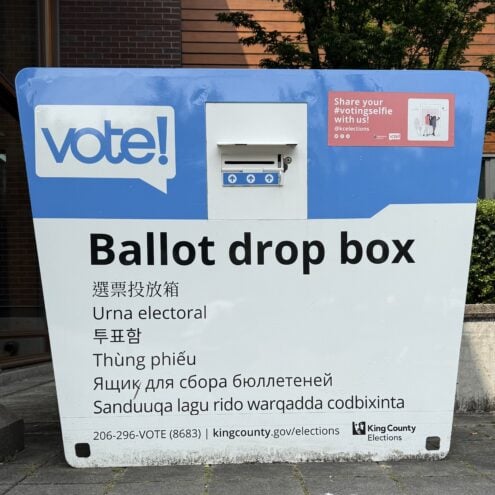 Photo by Jennie Cecil Moore.
KBCS: Washington’s primary election is in a few days on Tuesday August 4 – and the midterms are just a few months away. Meanwhile, The Trump administration has been targeting election laws and voting systems. The Supreme Court has eliminated some key protections of the Voting Rights Act. Now these actions by the federal government will play out state to state. KBCS Producer Jennie Cecil Moore spoke with a local voting advocacy organization to find out what it all means for Washington.
JCM: With all the activity around voting and elections, we did a check-in with Elise Orlick, executive director of FairVote Washington. The organization works on electoral reforms like ranked choice voting. They follow election legislation and policy.
JCM: Thanks for being here, Elise.
ORLICK: Thanks for having me, Jennie.
JCM: First off, there was a major ruling from the Supreme Court in June on mail-in voting. Can we talk about it and how it impacts Washington?
ORLICK: The relief is that it actually doesn’t change how we use mail-in ballots here in Washington. The court had the option to say that mail-in ballots received after election day could not be counted, even if they were postmarked by election day. And the court declined to do that, which means they respected the ability of states in their role to run elections.
The post office recently changed its internal rules around postmarking. And you can no longer count on your ballot being postmarked the same day that you deliver it to your mail carrier or the post office. Which is why we encourage voters, if you are voting within the last week before election day, it’s safer to use a drop box near you because there’s more unpredictability now.
JCM: Alright – redistricting has been a major factor around the country after a Supreme Court ruling in April on a congressional Louisiana map. Elise, what happened in that case?
ORLICK: Yeah, this decision, Louisiana versus Callais, is part of a years-long project really of the Supreme Court to dismantle the Voting Rights Act of 1965. Previously, Section 2 of the Voting Rights Act said that some jurisdictions were required to draw districts in a way that would ensure representation for minority communities within them.
The Supreme Court said not only does that requirement no longer exist, but it opened up the floodgates for districts that have the appearance of being drawn to ensure racial representation to be challenged as unconstitutional.
JCM: Ok. Washington is a pretty blue state, but what are the impacts here?
ORLICK: In the Yakima Valley area, there are state legislative districts, the 14th and 15th, where their boundaries were redrawn using the State Voting Rights Act in order to ensure representation for Latino voters. Since the Louisiana versus Callais decision, the Washington GOP has already tried to appeal that decision at the state level. They were unsuccessful. Now they are appealing those lines up to the Supreme Court and have said they are going to continue trying to change those maps back from the ones that were drawn to ensure representation.
JCM: Ok, well your organization, FairVote Washington, advocates for ranked choice voting, and the city of Seattle will be using it in 2027. How do you think that’s going to change things here in local elections and politics?
ORLICK: So starting next August, every city race is going to have a ranked primary election. Instead of filling in the bubble for the one candidate, you get to rank your first, second, third, fourth, and fifth choices. That means if your first choice can’t win, then your voice is still having a say and your vote transfers to your second choice candidate. What we have seen around the country is that we tend to have more candidates running for office when ranked choice voting is used. Voters tend to turn out at higher rates and are more likely to have someone that they support in office.
JCM: Alright, well turning to the midterms which are just a few months away, we chatted on the phone and you told me about our local elections. What should we expect here in Washington?
ORLICK: Bottom line, this year’s elections are going to be pretty much as normal. Voters shouldn’t be concerned about any major changes in 2026. Longer term, these threats to our elections are serious and it’s important that voters are aware of them and are ready to push back when they don’t agree. The reason we don’t see them affecting this year’s elections is because it takes a long time to get things passed and then to litigate them. And that process is almost certainly going to take beyond this November.
JCM: Elise Orlick is executive director of FairVote Washington. Thanks for being here.
ORLICK: Thanks for having me.
JCM: Ballots are due by Tuesday August 4 for the primary election. Like Elise said, if you haven’t gotten yours in yet, go to a drop box. You can find drop box locations on your county’s website – check out KingCounty. gov or PierceCounty.gov. There’s a new drop box at Bellevue College right near KBCS.
For KBCS, I’m Jennie Cecil Moore.